The Guide
Sports Cards 101
New to sports cards? This is a plain-English primer on the hobby itself — not this site. Card collecting runs on shorthand — “Kaboom SSP”, “/10”, “RPA”, “refractor” — and here’s what those terms actually mean, and why a handful of cards command the prices they do. Three things drive value: how scarce a card is, how much collectors want it, and its condition.
How rarity is measured
Many premium cards are serial-numbered — literally stamped “xx/99”. The smaller the number, the rarer the card: a card numbered /99 has 99 copies, a /10 has ten, and a 1/1 (“one of one”) is the only one on earth. Some chase cards aren’t numbered but are deliberately printed in tiny quantities — collectors call these SSPs (“super short prints”). Everything else is unnumbered, printed in larger, unpublished runs.
The inserts everyone chases



Kaboom! — a comic-book-styled insert with a bold, explosive design. It’s rarely numbered but printed extremely thin, and the artwork has made it one of the most recognizable and demanded cards in the hobby.
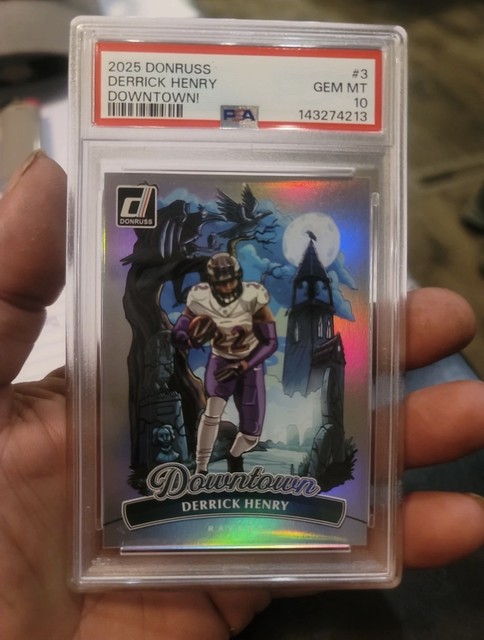
Downtown! — a case-hit insert showing the player against a stylized cityscape. They’re pulled roughly once per case, so supply is tiny relative to demand.
Color Blast — a vivid, paint-splash insert (found in sets like Phoenix). Another case-hit-level chase with no published print run, prized for how rarely it surfaces.
Prizm & refractors — “Prizm” (Panini) and “refractor” (Topps Chrome) are shiny, light-catching finishes. The plain Silver Prizm or base Refractor is the affordable, iconic rookie chase; colored parallels (Gold /10, Orange /25) and the SuperFractor (a 1/1) climb from there.
Sapphire — a Topps Chrome finish sold only online (not in retail packs), giving every card a rainbow-flecked shimmer. Because it skips the usual print run, it reads scarcer and pricier than a standard Chrome release of the same player.
Autographs & patches (RPAs)
An RPA — Rookie Patch Autograph — combines a player’s on-card signature with a piece of a game-worn jersey, from their rookie year. The premium lines (National Treasures, Flawless, Immaculate) number these low, which is why an RPA is usually a player’s single most valuable card. A “Logoman” (the NBA/NFL shield patch) is typically a 1/1 and the apex of the whole checklist.
Why grading matters
A third-party grader (PSA, BGS, SGC) authenticates a card and scores its condition from 1–10. A pristine PSA 10 can be worth many times the same card raw, because condition-sensitive surfaces — chrome, refractors, sharp corners — are hard to keep perfect. It’s why the same card can list at wildly different prices.
Rookies & “1st Bowman” (prospecting)
A rookie card (marked RC) is a player’s first officially licensed card in a major set — usually the cornerstone of their market. In baseball there’s an even earlier card: the 1st Bowman, printed while the player is still a prospect in the minors. Because it’s the earliest card, a star’s 1st Bowman Chrome autograph is often their true grail — more coveted than the later flagship rookie. Chasing these before a player breaks out is called prospecting.
How to read a card’s name
Listings pack everything into one line. Decoding “2018 Panini Prizm Silver #205 PSA 10”:
- 2018 — the year / season the set was released.
- Panini Prizm — the maker (Panini) and the product line (Prizm).
- Silver — the parallel/finish (here, the base Silver Prizm).
- #205 — the card’s number in that set’s checklist (not its rank or scarcity).
- PSA 10 — graded by PSA, condition 10 (gem mint).
Raw vs. slabbed (and the “pop report”)
A raw card is ungraded; a slabbed card is sealed in a graded holder. Slabbing adds trust (authenticity + an agreed condition), which is why a graded copy usually sells for more than the same card raw. Each grader publishes a pop report (“population”) — how many copies exist at each grade. A low pop at PSA 10 means gem-mint copies are genuinely scarce, which pushes the price up even on an unnumbered card.
Don’t get burned: reprints, fakes & “custom” cards
Not everything that looks like a grail is one. Reprints and “custom”/“ACEO” cards are unlicensed copies — often cheap, and never worth what a real card is. On vintage especially, buy graded copies from reputable sellers, and be suspicious of a price that’s far below the going rate. We filter reprints and customs out of our listings on purpose, and lean on graded copies, so the price you see reflects the real card.
The shorthand, decoded
- RC — rookie card, a player’s first major-set card.
- /99, /10, 1/1 — serial-numbered print run (copies made); 1/1 is the only one.
- SP / SSP — short print / super short print: rarer than the base set, unnumbered.
- RPA — rookie patch autograph (signature + game-worn jersey swatch).
- Logoman — the league-shield patch; almost always a 1/1.
- Parallel — the same card in a different color/finish, usually scarcer than the base.
- Case hit — a card pulled roughly once per sealed case; very limited supply.
- Comp — a recent sold price, the truest read on value.
- Pop — population: how many graded copies exist at a given grade.
So what’s a “grail”?
A grail isn’t simply the priciest card — it’s the most coveted: a blend of iconic status, scarcity, collector demand, and realized value. That’s exactly how our lists are ranked. Prices shown across the site are pulled live from eBay, and a listing price is an asking price — recent sold results are the truer signal of what a card is worth.