MLB · Grail List
Most Valuable Hank Aaron Cards
updated ·prices as of Sep 13, 2026
Did you know? A fun fact about Hank AaronThe ranking
- #1
 1954 Topps
Base Card
His only rookie card and the definitive Aaron grail, famous for picturing him batting left-handed by mistake. The most coveted and condition-sensitive card in any Aaron collection.
from $2,588.88 - #2
 1955 Topps
Base Card
His second-year Topps card, a classic mid-1950s issue and one of the most collected Aaron cards after the rookie.
from $299 - #3
 1955 Bowman
Base Card
His card in the 1955 Bowman 'TV set' — a desirable early Aaron from Bowman's final year before Topps acquired the brand.
from $200 The cards that anchor a Hank Aaron collection — his 1954 Topps #128 rookie, the classic mid-1950s Topps and Bowman issues, and his early flagship cards. These are vintage cards, so none carry printed print runs; ranked by grail status and collector demand, with prices updating live from eBay.
- #4
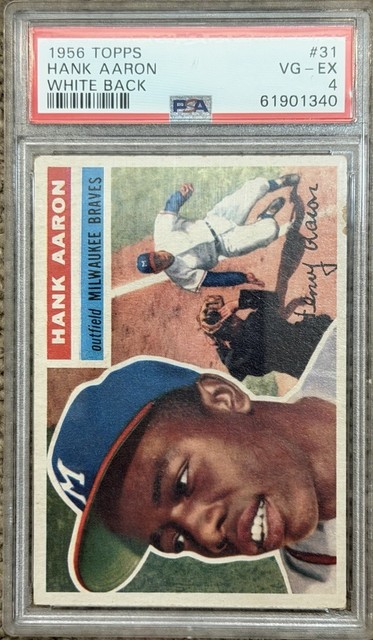 1956 Topps
Base Card
A beloved 1956 Topps card with the era's large action artwork — a cornerstone of any vintage Aaron run.
from $192.99 - #5
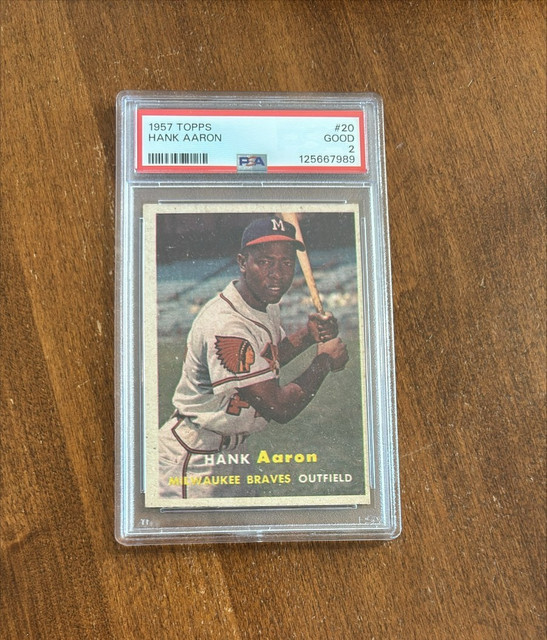 1957 Topps
Base Card
The 1957 Topps card, the first year Topps used real-photo fronts at the modern card size — a key early Aaron.
from $189.99 - #6
 1958 Topps
Base Card
A solid mid-career vintage Aaron from the 1958 Topps set, widely chased by collectors building his run.
from $154 - #7
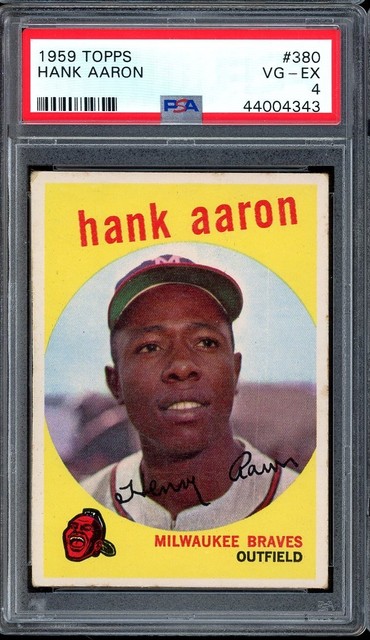 1959 Topps
Base Card
His 1959 Topps card, rounding out the classic 1950s Topps run of one of the game's greatest hitters.
from $140
Frequently asked
- What is Hank Aaron's rookie card?
- The 1954 Topps #128 is his one and only rookie card and the undisputed grail of any Aaron collection. He has no 1954 Bowman card, which makes the Topps rookie his single debut-year issue.
- What is Hank Aaron's most valuable card?
- The 1954 Topps #128 rookie is his most valuable and sought-after card, especially in high grade. Its scarcity in top condition, combined with its status as his only rookie, keeps it at the top of the market.
- Which other vintage Aaron cards are iconic?
- The 1955 Topps #47 and 1955 Bowman #179 are classic second-year cards, and his 1956 and 1957 Topps issues are cornerstones too. Each captures his early career with the Milwaukee Braves.
- Why don't these cards list a print run?
- Vintage cards were made long before manufacturers published print runs or serial numbers. Their scarcity comes from age, survival rate and condition rather than a stamped number, so no print run is confirmed for any of them.
- What should I watch out for buying vintage Aaron cards?
- Reprints, trimming and other alterations show up at this level, so third-party grading and authentication matter a lot. Buy graded copies from reputable sellers and study recent sales for the exact card and grade.
- Are Hank Aaron cards a good investment?
- Sports cards are collectibles, not guaranteed investments — even blue-chip vintage values move with the market and can fall. This page is for research and enjoyment, not financial advice; buy what you love and do your own homework.
Where this comes from
How we rank these cards
We rank by grail status — how coveted a card is — not by price alone. A card rises on its iconic standing (flagship rookies, on-card autographs, and marquee inserts), its scarcity (low serial numbers and true one-of-ones), and collector demand, with market value as a strong signal. The most expensive card isn't always the grail.
Every list is checked against several sources before it goes live. The facts — how rare a card is, what it sells for, which versions exist — come only from card checklists, price trackers, and real sold listings.
What the community is chasing shapes how we order the list, but it never counts as a fact on its own. It tells us about demand, not whether a card truly belongs at the top.
We only call a card's rarity confirmed when the maker officially publishes the number. Otherwise we label it an estimate — and we never make a number up.
Each card photo comes from the live eBay listing its button points to, so you're always seeing a real card that's actually for sale — credited to that listing, never taken from the card maker.