MLB · Most popular cards
Salvador Perez Rookie Cards & Most Hunted Cards
As of October 3, 2026, the most popular Salvador Perez card is the 2011 Bowman Sterling, listed from $244.75 on eBay.
Updated
The ranking
- #1
 2011 Bowman Sterling
Bowman Sterling
Widely regarded as his most valuable and hardest-to-find rookie card. Bowman Sterling was a high-end release, so far fewer base cards were opened than in regular Bowman.
from $244.75 - #2
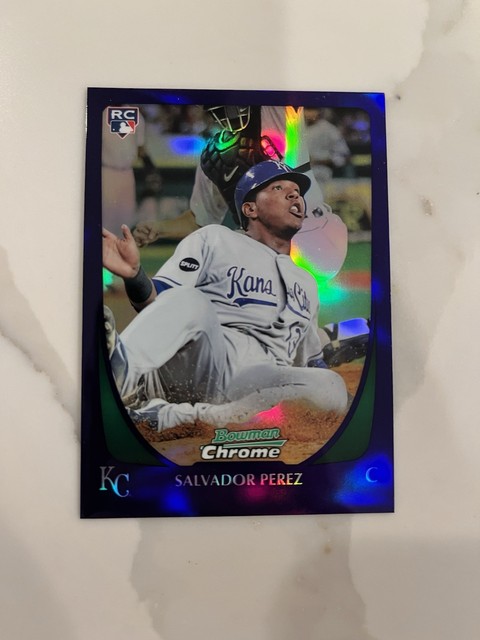 2011 Bowman Draft Chrome
Purple Refractor
The purple-tinted refractor of his Chrome rookie — one of the most valuable versions of the card, with a PSA 10 reported at $1,250.
last sold $149.99 from $349.99 - #3
 2010 Bowman Chrome
Prospects
His first mainstream card, from his prospect days — famous for the uncorrected Dodgers logo printed on the front. Not an official rookie card, but a long-time collector favorite.
from $29.99 - Fun fact
Perez was named MVP of the 2015 World Series, catching every inning as the Kansas City Royals won their first title in 30 years. In 2021 he hit 48 home runs, tying Johnny Bench's record for the most in a season by a primary catcher.
- #4
 2011 Bowman Draft Chrome
Blue Refractor
/199Blue refractor version of his Chrome rookie, numbered to 199.
last sold $185.13 - #5
 2011 Bowman Draft Chrome
Refractor
The classic rainbow-shine version of his Chrome rookie — a step up from the base card, with PSA 10 copies averaging around $265.
from $175 - #6
 2010 Bowman Chrome
Purple Refractor · Prospects
/899Purple refractor of his first mainstream card (Dodgers-logo error included), numbered to 899.
from $99.99 The Salvador Perez rookie cards collectors chase most — his three official 2011 rookie cards from Bowman Sterling and Bowman Draft, the shiny Chrome refractor versions, and his first mainstream card from 2010 Bowman Chrome. Ranked by grail status and collector demand; prices update daily.
- #7
 2011 Bowman Draft Chrome
Bowman Draft Chrome
His base Chrome rookie — the most popular everyday Perez rookie, with PSA 10 copies around $125.
from $16.84 - #8
 2011 Bowman Draft
Bowman Draft
The paper version of his Bowman Draft rookie — the most affordable of his three official rookie cards.
from $150 - #9
 2012 Topps
Base Card
His first flagship Topps card, from his first full season with the Royals. Not one of his official 2011 rookie cards, but an inexpensive classic.
from $65
Didn’t see the one you want? Browse 68 Salvador Perez cards for sale, $1 to $2,000
Looking for one of these? Join our card-hunting beta →
More MLB rookie cards
Frequently asked
- What is Salvador Perez's rookie card?
- He has three official rookie cards, all from 2011: Bowman Sterling #3, Bowman Draft #12, and the Chrome version of Bowman Draft #12. The Bowman Sterling card is the scarcest of the three.
- What is Salvador Perez's most valuable rookie card?
- The 2011 Bowman Sterling #3 is generally considered his most valuable and hardest-to-find rookie card. Among the more common rookies, the colored refractor versions of his 2011 Bowman Draft Chrome #12 bring the most, especially in top grade.
- Why does his 2010 Bowman Chrome card show a Dodgers logo?
- His 2010 Bowman Chrome prospect card (#BCP124) was printed with a Los Angeles Dodgers logo on the front by mistake, even though he was a Royals prospect. The error was never corrected, so every copy has it — and it's still the first mainstream Perez card collectors look for.
- What's the most affordable Salvador Perez rookie card?
- The paper 2011 Bowman Draft #12 and the base 2011 Bowman Draft Chrome #12 are the easiest ways in, usually costing far less raw than graded or refractor copies.
- Are Salvador Perez cards a good investment?
- Sports cards are collectibles, not guaranteed investments — values move with performance and hobby demand. This page is for research and enjoyment, not financial advice; buy what you love and do your own homework.
- What's a fun fact about Salvador Perez?
- Perez was named MVP of the 2015 World Series, catching every inning as the Kansas City Royals won their first title in 30 years. In 2021 he hit 48 home runs, tying Johnny Bench's record for the most in a season by a primary catcher.
- What's the most expensive Salvador Perez card for sale?
- As of October 3, 2026, the most expensive Salvador Perez card on our list that's for sale is the 2011 Bowman Sterling (#1), listed from $244.75 on eBay. If you'd rather buy one, the best Salvador Perez card under $100 is the 2010 Bowman Chrome Prospects (#3), listed from $29.99 on eBay. Prices update daily.
- What's the best Salvador Perez card under $100?
- As of October 3, 2026, it's the 2010 Bowman Chrome Prospects — #3 on our list of the 9 most popular Salvador Perez cards — listed from $29.99 on eBay. Prices update daily.
- What's the best Salvador Perez card under $500?
- As of October 3, 2026, it's the 2011 Bowman Sterling — #1 on our list of the 9 most popular Salvador Perez cards — listed from $244.75 on eBay. Prices update daily.
Where this comes from
Facts
Official rookie cards, Bowman Sterling as his most valuable rookie, 2010 Dodgers-logo error
How we rank these cards
We rank by popularity — how coveted a card is — not by price alone. A card rises on its iconic standing (flagship rookies, on-card autographs, and marquee inserts), its scarcity (low serial numbers and true one-of-ones), and collector demand, with market value as a strong signal. The most expensive card isn't always the most popular.
Every list is checked against several sources before it goes live. The facts — how rare a card is, what it sells for, which versions exist — come only from card checklists, price trackers, and real sold listings.
What the community is chasing shapes how we order the list, but it never counts as a fact on its own. It tells us about demand, not whether a card truly belongs at the top.
We only call a card's rarity confirmed when the maker officially publishes the number. Otherwise we label it an estimate — and we never make a number up.
Each card photo comes from the eBay listing its button points to, so you're always seeing a real card that's actually for sale — credited to that listing, never taken from the card maker.
Was this list helpful?