NBA Basketball cards · Most popular
Magic Johnson Rookie Card Value & Most Valuable Cards
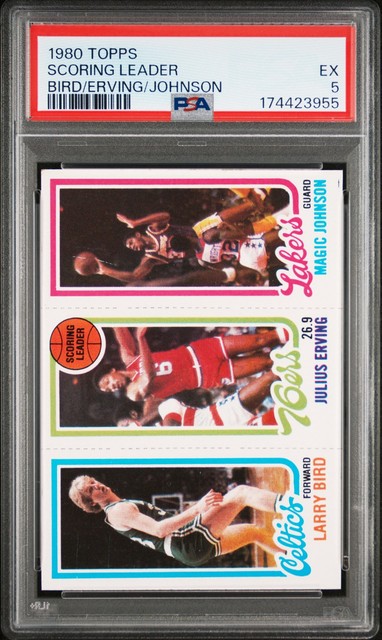
As of October 29, 2026, the most popular Magic Johnson card is the 1980 Topps Larry Bird / Julius Erving / Magic Johnson, listed from $1,350 on eBay.
Updated


The ranking
- 1980 Topps
Larry Bird / Julius Erving / Magic Johnson
Card #34 / 139 / 174The grail: his rookie card, a single three-player panel shared with Larry Bird and Julius Erving. Perforated to be torn apart, so intact high-grade copies are scarce — one sold for $861,000.
from $1,350 - 1980 Topps
Magic Johnson single
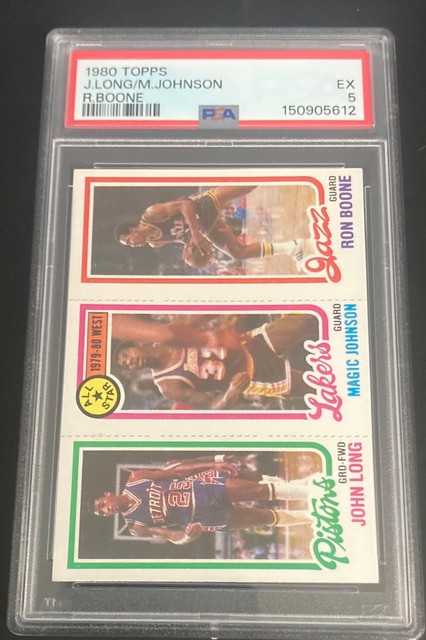
Card #139The separated Magic Johnson single from the 1980-81 panel — his individual rookie image, more affordable than the intact three-player card but still a cornerstone of any Magic collection.
from $60 - 1980 Topps
Magic Johnson All-Star
Card #18His 1980-81 Topps All-Star card — a second sought-after Magic appearance from his rookie set, distinct from the famous three-player rookie panel.
from $44.95
Fun fact
Magic's rookie card is one of the most famous in the hobby: a single 1980-81 Topps card printed as a three-player panel with Larry Bird and Julius Erving, meant to be torn apart along perforations. Most were separated, so intact high-grade copies are rare — one sold for $861,000.
- 1986 Fleer
Base Card
Card #53His 1986-87 Fleer card — one of the most iconic and widely collected cards of the era, and the most recognizable Magic card after his rookie.
last sold $228.50 from $129.99Recent salesSee all 5 sales
Date Grade Sold for Oct 22 PSA 8 $228.50 Oct 22 PSA 5 $108.51 Oct 22 CGC 7 $87 Oct 17 Raw $77 Oct 9 PSA 7 $107.50 - 1981 Topps
Base Card
Card #21His 1981-82 Topps second-year card — an early, affordable classic and a natural next step for collectors building around the 1980-81 rookie.
from $23Recent salesSee all 12 sales
Date Grade Sold for Oct 19 PSA 9 $800 Oct 19 Raw $10.49 Oct 18 Raw $15.50 Oct 18 Raw $30 Oct 18 Raw $26 Oct 18 Raw $20 Oct 15 Raw $23.25 Oct 14 Raw $12 Oct 13 Raw $24.25 Oct 9 PSA 8 $124.76 Oct 8 Raw $12.50 Oct 8 PSA 5 $26

- #61983 Star Company Star
Star Company Star
An early Star Company issue from the mid-1980s — unnumbered and produced in small batches, these are prized early-career cards that predate Magic's mainstream 1986-87 Fleer appearance.
Magic Johnson's rookie card is the 1980-81 Topps panel he shares with Larry Bird and Julius Erving, the perforated three-player card that is one of the most famous in the hobby. This guide ranks it alongside the separated Magic single, his 1980-81 All-Star card, and the Star and Fleer cards that followed, ordered by grail status and collector demand with prices that update daily.
Didn’t see the one you want? Browse 75 Magic Johnson cards for sale, $1 to $6,500
Shop the 2026 NBA draft class rookies
Missing a card from this list?
Looking for one of these? Join our card-hunting beta →
More NBA rookie cards
Frequently asked
What is Magic Johnson's most valuable card?
His 1980-81 Topps rookie card — the three-player panel he shares with Larry Bird and Julius Erving. Because the card was perforated to be torn apart, intact high-grade copies are scarce, and one sold for $861,000.
What are Magic Johnson's rookie cards?
Magic has one true rookie card: the 1980-81 Topps Larry Bird / Julius Erving / Magic Johnson panel (#34 / #139 / #174), a single card split into three perforated player panels. Copies torn apart along the perforations leave the Magic single (#139), which is the same rookie in separated form. The intact three-player panel is the grail version.
How much is a Magic Johnson rookie card worth?
It depends heavily on grade. An ungraded 1980-81 Topps Bird / Erving / Magic panel usually sells for somewhere around $800 to $1,000, PSA 8 copies for about $3,500 to $4,000, and PSA 9 copies for roughly $16,000 to $20,000. PSA 10 is extraordinarily rare, with only a couple dozen graded, and those have sold for more than $500,000. Check the live prices on each card above for today's market.
How rare is the Magic Johnson rookie in top grade?
The card itself was mass-produced, but its perforated three-panel design made it prone to bending and creasing, and most were torn apart. That makes clean, intact, high-grade copies genuinely scarce and by far the most valuable versions.
What's the most affordable Magic Johnson card to start with?
His 1986-87 Fleer card (#53) and his early-1980s Topps issues are the accessible entry points — iconic, widely available, and usually the cheapest way into a Magic collection. Signed modern cards from premium sets sit at the high end.
Which Magic Johnson card is best to get graded?
His 1980-81 Topps rookie is the one where grading matters most, since condition and whether the panel is intact drive its value dramatically. Compare recent graded sales before paying to grade any vintage card.
Are Magic Johnson cards a good investment?
Sports cards are collectibles, not guaranteed investments — values move with hobby demand and can fall as fast as they rise, and vintage condition is everything. This page is for research and enjoyment, not financial advice; buy what you love and do your own homework.
What's a fun fact about Magic Johnson?
Magic's rookie card is one of the most famous in the hobby: a single 1980-81 Topps card printed as a three-player panel with Larry Bird and Julius Erving, meant to be torn apart along perforations. Most were separated, so intact high-grade copies are rare — one sold for $861,000.
What's the most expensive Magic Johnson card for sale?
As of October 29, 2026, the most expensive Magic Johnson card on our list that's for sale is the 1980 Topps Larry Bird / Julius Erving / Magic Johnson (#1), listed from $1,350 on eBay. If you'd rather buy one, the best Magic Johnson card under $100 is the 1980 Topps Magic Johnson single (#2), listed from $60 on eBay. Prices update daily.
What's the best Magic Johnson card under $100?
As of October 29, 2026, it's the 1980 Topps Magic Johnson single — #2 on our list of the 6 most popular Magic Johnson cards — listed from $60 on eBay. Prices update daily.
What's the best Magic Johnson card under $500?
As of October 29, 2026, it's the 1986 Fleer — #4 on our list of the 6 most popular Magic Johnson cards — last sold for $228.50. Prices update daily.
Where this comes from
How we rank these cards
We rank by popularity — how coveted a card is — not by price alone. A card rises on its iconic standing (flagship rookies, on-card autographs, and marquee inserts), its scarcity (low serial numbers and true one-of-ones), and collector demand, with market value as a strong signal. The most expensive card isn't always the most popular.
Every list is checked against several sources before it goes live. The facts — how rare a card is, what it sells for, which versions exist — come only from card checklists, price trackers, and real sold listings.
What the community is chasing shapes how we order the list, but it never counts as a fact on its own. It tells us about demand, not whether a card truly belongs at the top.
We only call a card's rarity confirmed when the maker officially publishes the number. Otherwise we label it an estimate — and we never make a number up.
Each card photo comes from the eBay listing its button points to, so you're always seeing a real card that's actually for sale — credited to that listing, never taken from the card maker.
Was this list helpful?