NHL Hockey cards · Most popular
As of November 28, 2026, the most popular Mario Lemieux card is the 1985 O-Pee-Chee, listed from $314.99 on eBay.
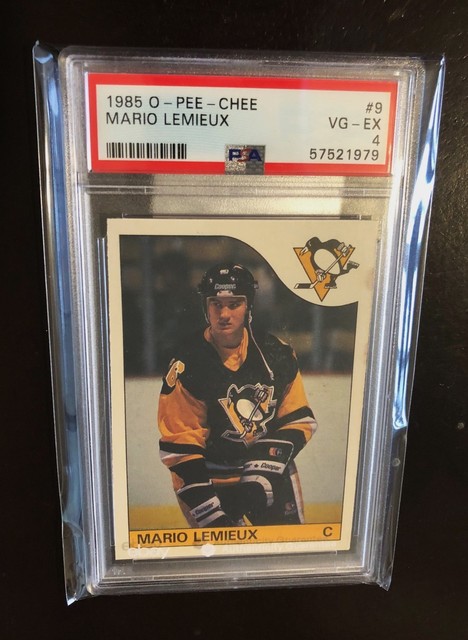
His rookie card, from the Canadian O-Pee-Chee printing: the Lemieux card every collector wants, and one of the most valuable hockey cards of the 1980s.
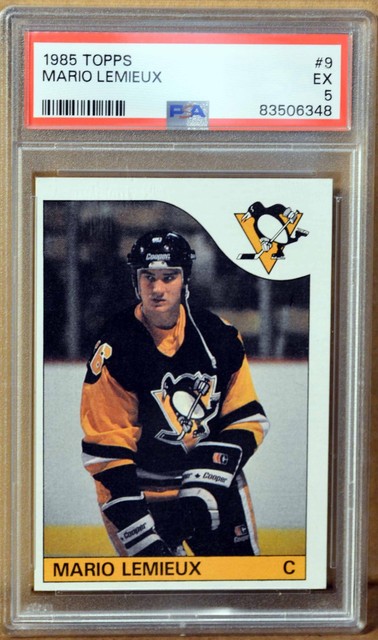
The American printing of his rookie card: the same photo and number as the O-Pee-Chee version, easier to find in high grade and much cheaper.
Mario Lemieux auctions with bids, closing soonest (bids as of Nov 28, 2026).
The rookie-year card printed on the bottom of wax boxes, which collectors had to cut out by hand, so clean copies are scarce.
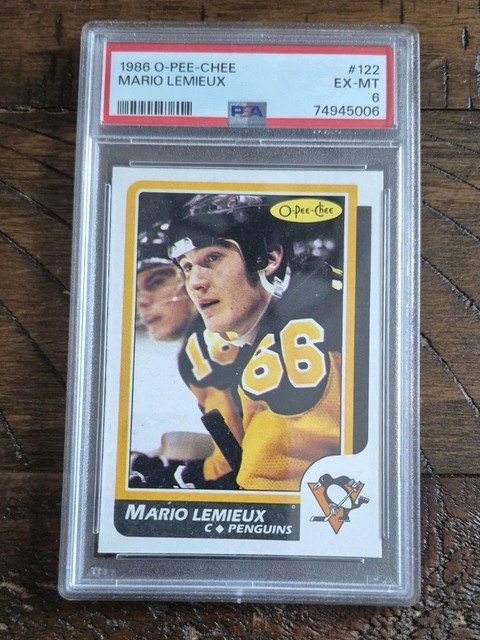
His second-year O-Pee-Chee card, from the set that also holds the Patrick Roy rookie: a cheaper way into his 1980s cards.
On March 2, 1993, Lemieux had his final radiation treatment for Hodgkin's lymphoma in Pittsburgh in the morning, flew to Philadelphia, and scored a goal that night in his first game back after missing 23 games.
Card #1 in the 1988-89 set, from the season he scored 199 points: being the first card in the set, it was often damaged in boxes, so sharp copies cost more than you'd expect.
A hologram insert from 1991-92 Upper Deck marking his trophy season, from the year after Pittsburgh's first Stanley Cup.
His card from Upper Deck's first hockey set, printed on the glossy stock that made the brand: common, cheap, and a favorite for grading.
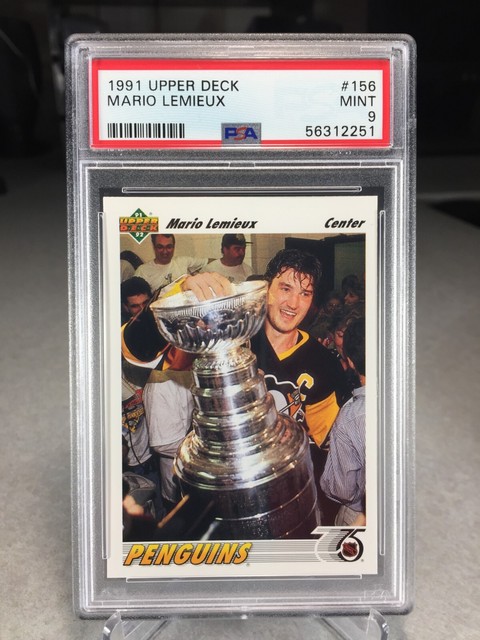
His 1991-92 Upper Deck card, from the season he won the Conn Smythe Trophy as the playoffs' best player.
The cards that anchor a Mario Lemieux collection: his 1985-86 O-Pee-Chee #9 rookie, one of the most valuable hockey cards of the 1980s, its Topps twin, the hand-cut box-bottom version, and his Pittsburgh Penguins cards through the Stanley Cup years. Lemieux, Super Mario, won two Cups as a player and later bought the team. Ranked by grail status and collector demand; prices update daily.
A Platinum-era Pro Set card from the back-to-back Cup years: among the most affordable Lemieux cards there is.
Didn’t see the one you want? Browse 76 Mario Lemieux cards for sale, $1 to $562
Found a Mario Lemieux card on eBay? Check if it’s a good price
Missing a card from this list?
Looking for one of these? Join our card-hunting beta →
His rookie card is #9 in the 1985-86 set, printed in two versions: O-Pee-Chee (the Canadian printing, the one collectors pay most for) and Topps (the American printing). A hand-cut box-bottom version, #I, came on the bottom of 1985-86 wax boxes.
O-Pee-Chee printed far fewer cards in Canada and its cards are notoriously hard to find well-centered with sharp corners, so high grades are much scarcer. The two cards use the same photo and the same number.
His 1988-89 O-Pee-Chee #1, 1990-91 Upper Deck #144 and 1991-92 Pro Set Platinum #91 are the cheapest ways in, usually a few dollars to a few tens of dollars raw, and all three show him in his prime Penguins years.
Sports cards are collectibles, not guaranteed investments. Vintage prices move with the grading market and with demand for 1980s hockey. This page is for research and enjoyment, not financial advice; buy what you love and do your own homework.
On March 2, 1993, Lemieux had his final radiation treatment for Hodgkin's lymphoma in Pittsburgh in the morning, flew to Philadelphia, and scored a goal that night in his first game back after missing 23 games.
As of November 28, 2026, the most expensive Mario Lemieux card on our list that's for sale is the 1985 O-Pee-Chee Box Bottoms (#3), listed from $2,110.29 on eBay. If you'd rather buy one, the best Mario Lemieux card under $100 is the 1986 O-Pee-Chee (#4), listed from $64 on eBay. Prices update daily.
As of November 28, 2026, it's the 1986 O-Pee-Chee — #4 on our list of the 9 most popular Mario Lemieux cards — listed from $64 on eBay. Prices update daily.
As of November 28, 2026, it's the 1985 O-Pee-Chee — #1 on our list of the 9 most popular Mario Lemieux cards — listed from $314.99 on eBay. Prices update daily.
We rank by popularity — how coveted a card is — not by price alone. A card rises on its iconic standing (flagship rookies, on-card autographs, and marquee inserts), its scarcity (low serial numbers and true one-of-ones), and collector demand, with market value as a strong signal. The most expensive card isn't always the most popular.
Every list is checked against several sources before it goes live. The facts — how rare a card is, what it sells for, which versions exist — come only from card checklists, price trackers, and real sold listings.
What the community is chasing shapes how we order the list, but it never counts as a fact on its own. It tells us about demand, not whether a card truly belongs at the top.
We only call a card's rarity confirmed when the maker officially publishes the number. Otherwise we label it an estimate — and we never make a number up.
Each card photo comes from the eBay listing its button points to, so you're always seeing a real card that's actually for sale — credited to that listing, never taken from the card maker.